Asia/Bangkok
Blog
October 5, 2026·6 min read
TCG & Collecting

A Card Collection Tracker That Dates Every Price

Kaung Ye Marn
A Card Collection Tracker That Dates Every Price
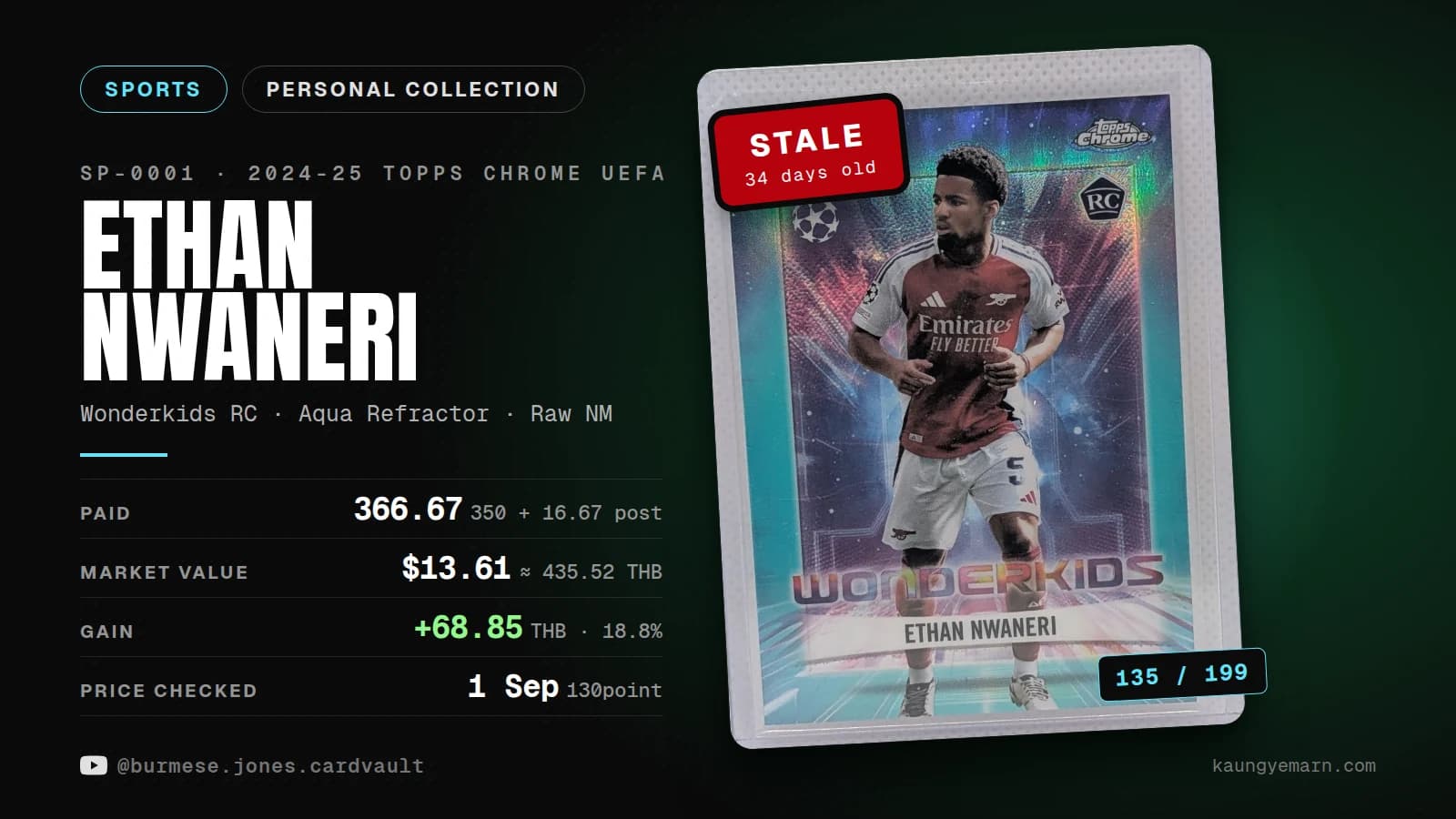
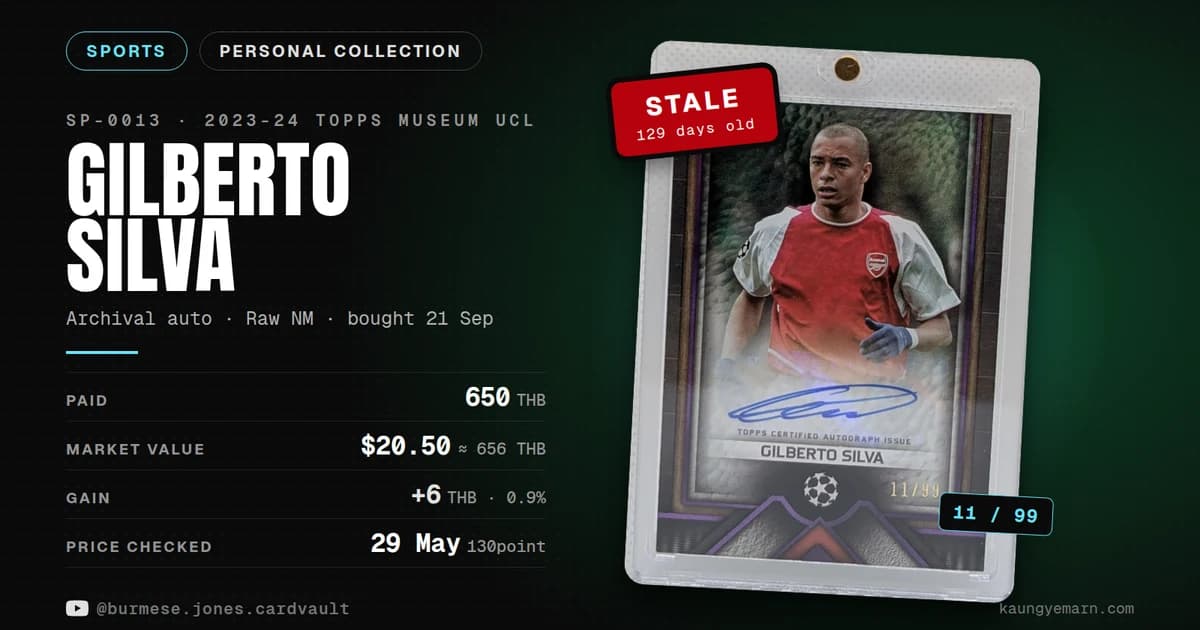
The Gilberto Silva autograph I bought on 21 September is, according to my own spreadsheet, worth six baht more than I paid for it. I paid 650. The sheet says 656, a gain of 0.9 percent, and if you glanced at the total at the bottom of the page you would never think twice about it. The price behind that 656 was looked up on 29 May, which is 115 days before I bought the card and 129 days before I wrote this. Nothing in the sheet was wrong. I typed the value in, and the value was correct on the day I typed it. The trouble is that a price in a cell looks the same on the day it goes in and a hundred days later, and every total you add up from those cells inherits that false calm. Collectors ask what the collection is worth, and the question has a flaw: it assumes the answer is a number. The answer is a number plus a source plus a date, and a sheet that keeps the number while dropping the other two is quietly answering a different question, which is what each card was worth on whichever day you last felt curious. The tracker I built for Burmese Jones Card Vault stores three things where most sheets store one. Beside every market value sits the source, which for me is 130point, where I look up what a card actually sold for, and the date I checked it. A fourth column compares that date to today and writes OK or Stale. Stale appears once the value is more than 30 days old, a limit you can change on the settings tab, and the cell turns red. Cost gets the same treatment. The purchase price, the postage or tax and any grading fee are separate cells that add into one cost basis, so the Nwaneri refractor shows 366.67 baht rather than the 350 the seller asked. Sixteen baht looks like nothing on one card. Across a few hundred, ignoring it is how a profit column drifts away from the bank statement. An exchange rate is another price with a date on it. I buy in baht, sell in baht and in kyat through KBZPay, and enter market values in dollars. Each transaction keeps its own baht-to-kyat rate, and the sheet converts dollars at the rate on the settings tab, so the Nwaneri value of $13.61 becomes 435.52 baht at 32 to the dollar and nobody does that sum in their head at a card meet. Both cards in the photographs are flagged, and they are not stale in the same way.
CardPaid (baht)Market valuePrice checkedAge at writing
Ethan Nwaneri, Topps Chrome UEFA Wonderkids Aqua Refractor, 135/199366.67$13.61, about 435.52 baht1 Sep34 days
Gilberto Silva, Topps Museum Collection archival auto, 11/99650$20.50, about 656 baht29 May129 days
Ethan Nwaneri Topps Chrome UEFA Wonderkids RC Aqua Refractor, numbered 135 of 199, in a toploader beside a spec plate showing a 366.67 baht cost, a 13.61 dollar market value and a red Stale stamp reading 34 days old
The Nwaneri price is 34 days old, four past my own limit. Taken at face value it says I am up 68.85 baht, or 18.8 percent, and I would trust that to within a few baht. The Silva price predates the purchase, so the 0.9 percent gain belongs to a card nobody has priced since before I owned it. It could be up, down or exactly where the sheet says it is. What the sheet knows for certain is how old the number is, and that turns out to be the most useful fact on the row. When I am selling, one more column earns its place. Next to the market value I keep my asking price and the sheet shows how far above or below market it sits. My Nwaneri ask is 450, 3.3 percent over a value that is itself 34 days old. Dating the number does not tell me what to charge. It tells me when to stop trusting my own arithmetic and look the card up again. The tracker is two Excel files in a public Google Drive folder: a blank one, and one with example cards and a sale already entered so you can watch the dashboard and the Stale flag work before you trust them with your own. It has tabs for Pokémon, One Piece and sports cards, with pre-numbered card IDs, and a sale flips a card to Sold and works out profit, margin and days held for you. The tracker page has the walkthrough and both downloads. It is free to use for your own collection or card business. I ask that you do not resell it, with or without changes, and if a friend wants a copy, send them the page rather than the file so the licence arrives with it. Start smaller than you think. Enter the last three cards you bought with the real price paid including postage, then look each one up today so that every row carries a source and a date from the same afternoon. A few weeks on, the sheet will start telling you which of those lookups to redo, which is a better use of ten spare minutes than typing in card number four. The test in The Case for Buying Fewer Cards asks what a card means to you beyond the set it completes. This is the other half of that filter: what you paid, what the market said, and when it said it. A collection can be small and still be wrong about its own total. As I write this, my Silva is in its magnetic case with a 129-day-old price, flagged red. The sheet will keep flagging it until I look the card up again.
Share this post:

Recent posts